
- 30%

VerVita XXL, white (used) 2
SKU: 160W (br.2)
€217.00
Product currently not available.
Enter your email address and we will notify you when the product becomes available again.
Lowest Price Last 30 days
VerVita XXL, white (used) 2: €310.00
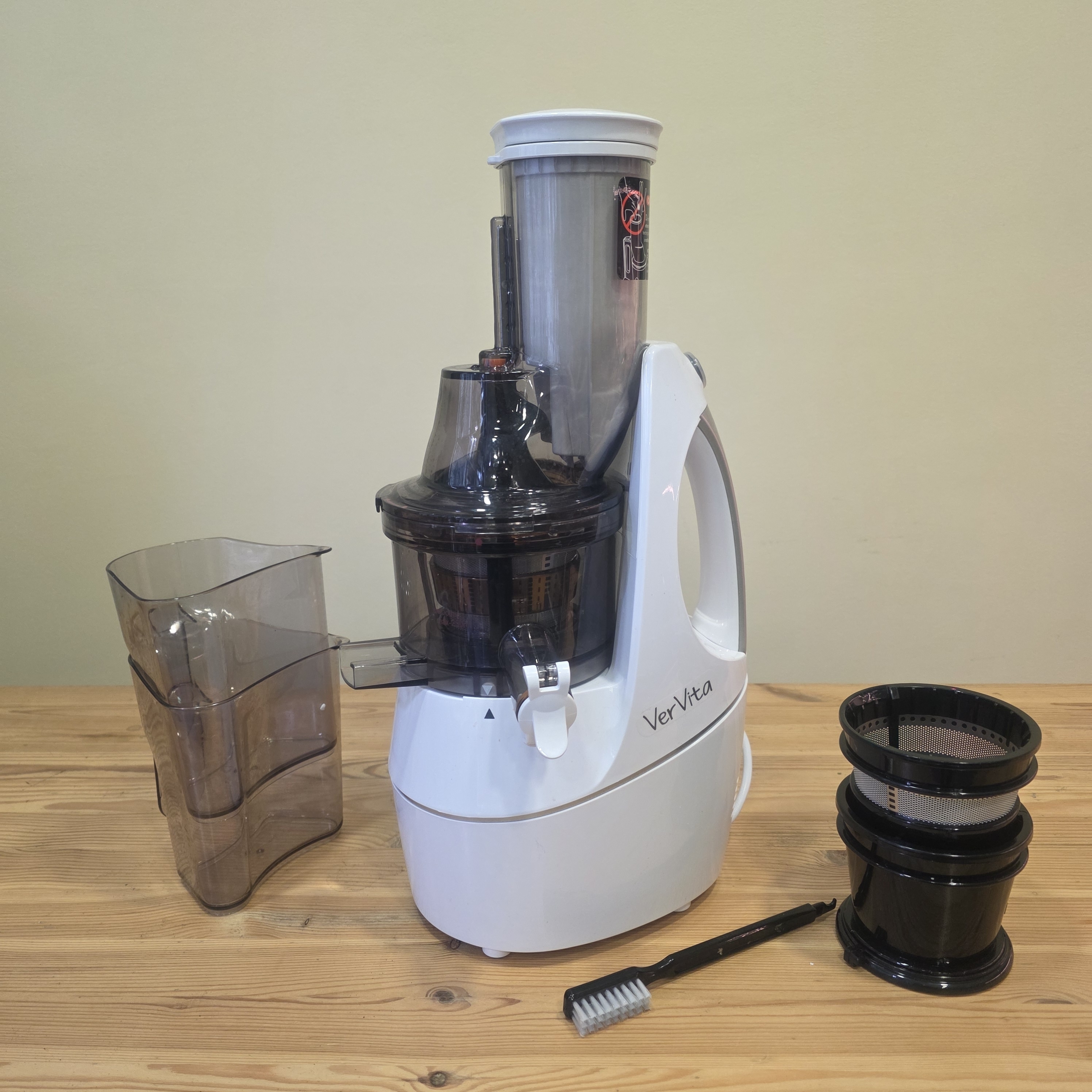
VerVita XXL, white (used) 2
SKU: 160W (br.2)
€217.00
Lowest Price Last 30 days
VerVita XXL, white (used) 2: €310.00
Product currently not available.
If you are looking for a way to preserve and restore your health, a cold-press juicer, like the VerVita XXL, will be one of the first on your kitchen appliance shopping list. Since the VerVita XXL juicer package includes, in addition to the juice strainer, a thick juice/puree strainer and an ice cream (sorbet) strainer, it may be the only appliance you will need, as this is a true 3-in-1 device.
At only 65 revolutions per minute , it slowly squeezes fruits and vegetables, preserving all the vitamins, minerals and enzymes in the resulting juice. What can you squeeze:
- Fruit (apples, oranges, pineapple, pomegranate, strawberries, lemons, strawberries...)
- Vegetables (carrots, beets, cucumbers, cabbage, peppers, tomatoes...)
- Green leafy vegetables (spinach, Swiss chard, kale, celery, carrot leaves...)
- You can also make plant-based milks (almond, soy, oat...)
Along with the standard juicer sieve, you get 2 additional sieves in the package:
- one making thick juices/pureeing
- another for making ice cream from frozen fruit with the possibility of adding dried fruit and nuts!
Self-cleaning mechanism - The juicer only needs to be cleaned once a day! After use, run about 1l of water through the juicer while it is still running and turn it off. It can sit there until the next use - juice fruits and vegetables all day long with just one juicer cleaning!
Quick and easy disassembly and cleaning - consists of only 5 parts that need to be cleaned (lid, screw, sieve, silicone sieve cleaner and strainer), which takes 2-3 minutes with the help of the brushes that come in the package.
Large food opening – no need to cut food into small pieces
Quiet operation – incomparably quieter compared to centrifugal juicers
Juice outlet cap prevents dripping
WHAT'S IN THE BOX: 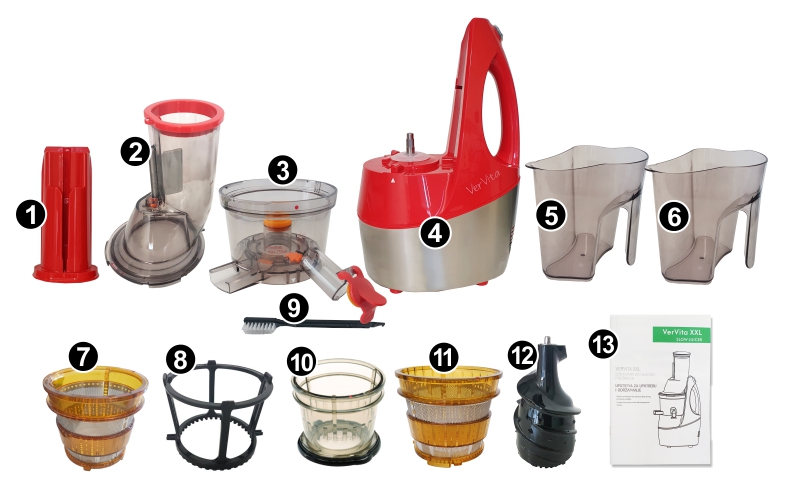

QUICK RINSE BEFORE WASHING - Pour water into the inlet funnel to rinse the inside of the juicer before washing or to rinse the taste between juicing different juices . If you juice several times during the day, after use, run about 1l of water through the juicer while it is still running to rinse it, making sure that the water does not exceed the maximum capacity of the drum, drain all the water, turn off the juicer and remove the upper part of the juicer (all together or separately, piece by piece) to the side until the next juicing or immerse it in water. However, if you juice only once a day, it is advisable to wash the juicer immediately after juicing.
BEWARE!!! If you leave the juicer parts of your juicer unwashed every day, there is a risk that water or juice will leak into the juicer (into the motor) and this is not covered by the warranty.
Quick and easy disassembly and cleaning - consists of only 5 parts that need to be cleaned (lid, screw, sieve, silicone sieve cleaner and strainer), which takes 2-3 minutes with the help of the brushes that come in the package.
Large food opening (75mm) – no need to cut food into small pieces.
Quiet operation – it is incomparably quieter compared to centrifugal juicers.
The plug on the juice outlet prevents dripping.
The warranty for home use is 5 years for the engine and 1 year for other parts.
JUICER REVIEW (zelenarium.com) ->
WHAT FOODS SHOULD YOU PAY SPECIAL ATTENTION TO WHEN JUICING:
1. Hard pits: peach, apricot, nectarine, plum, cherry, mango and similar fruits with hard pits. If any of these pits fall into the sieve, the sieve will inevitably break.
2. Stems: The woody stems of apples and pears can deform the mesh of the sieve responsible for squeezing the juice, so a deformed sieve results in less efficiency and a higher density of juice.
3. Pineapple core: properly cut pineapple core is easy to squeeze (it is healthy, don't throw it away!) only if it is cut crosswise into slices 5-7 mm thick. If the pineapple core fibers are longer than the stated 5-7 mm, they first clog the sieve opening and the pulp outlet, and further squeezing with the sieve opening and pulp opening blocked inevitably leads to a slight deformation of the sieve.
4. Lemon: Note that the top and woody stem of the lemon can sometimes be extremely hard, so it's best to cut them off before adding the lemon. If you're juicing hard homemade lemons with the peel on, be sure to cut them into quarters and add the quarters one at a time, not all at once. There are no restrictions for peeled lemons.
5. Beetroot: Fresh beetroot can sometimes be extremely hard. Do not cut into quarters. Large, hard beetroot quarters can damage the lid. Be sure to cut the beetroot into large slices, 5-7mm thick, just like you would cut a potato for a roasting rack. Add the whole slices one at a time, waiting a few seconds between adding two slices, or even better, add an apple quarter after each beetroot slice. Note that the juicer takes significantly longer to process beetroot than it does to process the same amount of apples or oranges – do not overfill the juicer with beetroot.
6. Wild pomegranate (rosehip): it is a fruit without juice, with hard seeds that will easily destroy the juicer's sieve.
7. Blackberries and chokeberries. After juicing, these berries do not have real pulp, but only small pits that have the texture of sludge when squeezed and the juicer cannot expel them... the pulp becomes "concreted". After a small amount of about 0.5 kg, the pulp opening is completely blocked, pulp accumulates under the screw, and with further juicing, the lid, sometimes the lid and the drum always break, and in the most severe cases of jamming the juicer with chokeberries, the sieve is deformed along with the lid and drum. This blockage can be avoided by mixing an apple with the chokeberries and blackberries, which will add real pulp. When juicing pure chokeberries, the best results are achieved as follows:
a) Don't overcrowd chokeberry, don't pour in too quickly. Insert at an even pace that is approximately the same as the speed at which the juicer manages to extract the inserted material.
b) After every 2-3 dcl of juice, stop adding aronia berries, wait about 10 seconds for the juice to stop coming out, and turn off the juicer.
c) Try unscrewing the lid just a few cm, if it can be unscrewed easily, screw it back on and you can strain the next 2-3 dcl.
d) If the lid is difficult to unscrew, juicing is OVER, because pulp has started to accumulate under the screw and the screw is lifting. It is necessary to disassemble the entire juicer head, wash the sieve, drum and all screw channels of accumulated "stone sludge".
e) After washing, you can assemble the juicer and start juicing again.
8. For grapes and domestic Dalmatian pomegranate , if squeezed cleanly, in quantities larger than 0.5l, as a precaution, proceed as for chokeberry, although even with larger quantities, the sieve opening does not usually become clogged as with chokeberry, except very rarely with some grape varieties.
You can juice the following pitted fruits without restrictions : apple, pear, orange, grapefruit, lemon, tangerine, watermelon, cantaloupe, etc. The juicer easily grinds the pits of these fruits and ejects them with the pulp.
Centrifuge or cold pressing?
This video instructively shows the difference between centrifugal juicers and juicers that work exclusively on the cold-press principle: https://youtu.be/LdwFQviOXAI
The second model in the video from the right, the Optimum 600, is identical to the VerVita XXL model from 2014, which by 2019 had evolved into the current VerVita XXL model 2019, with many improvements in design, durability, and juice quality since the first model from 2014. It is not noticeable in the video that the white juicer on the left, which is advertised as extremely easy to clean, actually has no outlet for the pulp, the pulp accumulates in the sieve, and the user who mistakenly buys it will be surprised when he realizes that he has to disassemble and clean it after every 2 small glasses of juice. The VerVita XXL easily makes 10-15 liters of juice continuously without turning it off and cleaning, the video says everything about the drastic difference in juice quality, and the difference in usability is great for all foods in favor of the XXL model, especially for greens that are practically impossible to juice well in a centrifuge.
Recommendation for the longest possible lifespan of your juicer:
Once a month, immerse the entire juicer head in warm water and sprinkle it with 4-5 tablespoons of citric acid and the same amount of baking soda. After the reaction has calmed down, leave the parts in the solution for a few hours or overnight and brush all parts well with the included brushes and rinse under running water.
Power: 240W
Speed: 65 revolutions per minute
Dimensions: 25 x 18.3 x 48.3 cm
Weight: 6.5kg
Warranty for home use: 7 years on the motor, 1 year on other parts
Customer Reviews
- 0
- 0
- 0
- 0
- 0
Most helpful positive review
No reviews yet.